
If you bring up the term “brand lore,” you’re likely to get confused stares in the best case, or watch someone’s eyes glaze right over in the worst. It sounds like one of those buzzwords that gets trotted out every few years and doesn’t have much heft or significance.
In this case, we’re happy to report that that’s an incorrect assessment of the term.
First, let’s make it clear. What exactly is brand lore?
Simply put, it’s the accumulated history, mythology and shared cultural universe that people repeat and co-create.
Read that sentence again and several things will stand out. First, business owners don’t have full control over their own brand lore. Second, customers and non-customers alike contribute to the creation of your lore.
If you have a spectacularly bad product roll out, everyone will be talking about it, possibly for years. Even people who have never made a purchase from you. That’s going to be part of your brand lore. How you handle the spectacularly bad rollout is also going to be part of your brand lore, but again, you only control one part of that narrative. What the people watching you decide about how you handled it…that’s an indelible part of the story and not fully up to you.
Maybe the general public will develop inside jokes or biting memes about you, the upper management team, your company, or the particular product that was at the center of the bad rollout.
Maybe none of that will happen, but your adroit handling of the issue will mark your company as having legendary status for turning a failure into a win. The specific direction Brand Lore takes can be difficult to predict, or even steer.
Here’s another thing to consider. Brand Lore is impossible to fake. You can’t AI slop your way into, or out of it, and in fact, if you become known as a company who leans heavily on AI slop, well, that too is going to become part of your Brand Lore.
Few people have summed the matter up better or more succinctly than Branding Expert (and author of the book “Brand Intervention”) David Brier, who said as much in an interview with The CEO Magazine.
“If you don’t give the market the story to talk about, they’ll define your brand’s story for you.”
So what does that look like in practice?
The truth is, it can take almost any form you can imagine. The important bit is to take an active stance and tell your story personally, either through corporate actions (promoting or getting behind causes you care about and letting people know that), or how you handle bad rollouts and bad reviews.
It can also take the form of mascots, and this is a theme that honestly, too few companies embrace. A few recent examples come to mind.
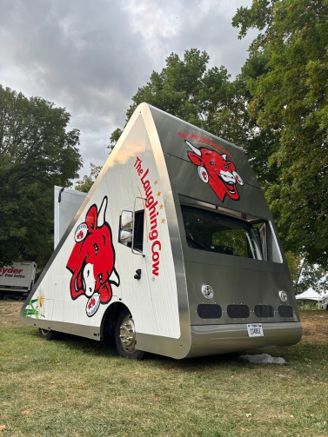
The Laughing Cow Company, known for its creamy spreadable cheese wedges, has toured multiple countries in a truck pulling a cheese-wedge shaped trailer behind it, complete with their laughing cow logo. They literally don’t need advertising beyond that. Anyone even vaguely familiar with the company knows exactly what they’re looking at, and the people who aren’t will probably get curious and look them up online.
Crocs, the famous shoe company, ran a two-year long ad campaign featuring a guy in an alligator costume. It was seen as a bit of a risky move for the company at the time, which had a reputation for being all functional and no-nonsense, and their alligator character (which made both TV and live appearances) was on the quirky/light-hearted side. Any fears they may have had about the idea were short-lived, however, as the campaign was a rousing success that is still talked about in Crocs circles to this day.
The Desperados beer company teamed up with designer Paolina Russo to design a “frozen beer jacket” that instantly became part of the company’s brand lore. The idea is, if you’re at a concert, holding onto your drink and staying cool are two sizeable problems. The jacket solves both. You load it with frozen beer and as it starts to melt, you can enjoy a refreshing drink thanks to the straw built into the collar!
Granted, depending on the kind of company you run, and the products you sell, you may not be able to do anything quite as fun as a frozen beer powered jacket with courtesy straw, but the core idea is sound. Find a thing. Maybe it’s a serious thing and maybe it’s a fun/quirky thing, but find it and make it your own. Use it to tell your story. That’s powerful marketing.